


Teaching Texting
“Think of texting as a JV version of social media.”
At ScreenSense, we recommend delaying group texting until middle school AND really leaning in to teach your child how to text. Texting is typically premature in elementary school, is complex and needs a lot of parental guidance in middle school, and is usually a great tool in high school. But like any form of communication, how to text needs to be modeled, taught, and practiced. It helps to delay group texting together - as a local community - to reduce the social pressure on parents and kids. Then when the time comes, texting should be rolled out with guardrails and ongoing conversations.

The reality of young kids texting
There comes a time when our kids want to directly communicate with each other. When we say yes to texting, we imagine our child being a savvy communicator who uses texting as a tool to make plans and ask about homework. But the reality is often very different and we hear a lot of complaints from elementary and middle school parents who have experienced first-hand when group texting has gone awry.
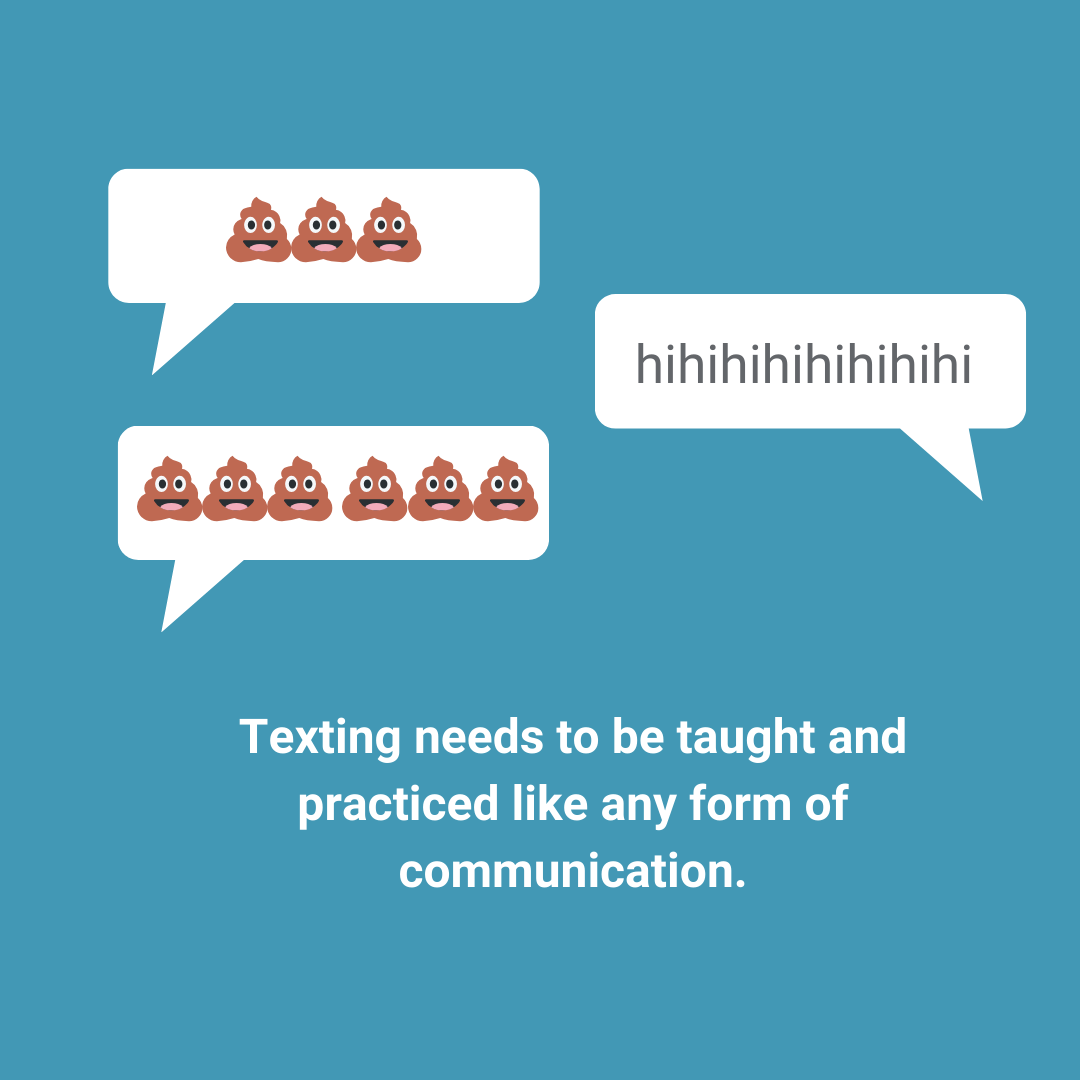
Here’s the reality: a young texter walks away from their iPad for an hour and returns to find 300+ new texts on a group text thread. One kid spammed everyone on the text thread with the entire alphabet, one letter at a time in separate texts. Two others exchanged a long set of nonsensical emojis. Occasional unanswered questions were peppered in between but quickly buried. Another kid sent a YouTube video about how to build muscles. Another sent a TikTok video about hair products. And yet another sent a series of memes grabbed from the internet - some were sort of cute or entertaining, others were questionable and borderline inappropriate.
Overall, it was a lot of noise to process and no meaningful interactions or communication took place. And this is a relatively “good day” on a typical group text among younger kids. Other days it devolves into misunderstandings, drama, exclusion, needless pressure to respond quickly (hello????), and hurt feelings.
Texting guidelines by age
Ages 0-5
No texting at this age.
K-4th grades
No unsupervised texting at this age.
Get ahead of social pressure by talking with other parents about delaying texting among friends until middle school.
Need a way for kids to connect?
Get a landline as an alternative to texting! Facetime is also better than texting. Encourage knocking on friends’ or neighbors’ doors and making plans face-to-face while at school.
In upper elementary:
If your child shows interest in texting, you can model, coach, and co-write texts from a parent’s phone to start teaching etiquette. Share teachable moments as they arise on your own phone - e.g., show your child unwanted spam you get and how you handle it, explain when you choose to call someone instead of texting them.
If your child gets a mobile device like a smartwatch or iPad, texting with parents is a low-stakes learning ground. Parents can model and give feedback while they practice texting.
5th-8th grades
Delay texting with friends as long as you can, until it’s a social necessity. It’s best to wait until middle school. Delay the social necessity by collectively delaying texting with other parents in your child’s social circle.
A landline or FaceTime is a great alternative to texting!
Texting - like any form of communication - needs to be modeled, coached, and practiced. So, delay access to texting until you’re ready to lean in and teach.
Ready to roll out texting?
See below for suggested next steps.
Lessons on what to text, what not to text, and when and how to respond are essential.
9th-12th grades
Texting, phone calls, and FaceTime are great forms of digital communication in high school (and preferable to social media)!
Coach healthy and safe digital communication. Check in with your teen about the upsides and downsides of texting, and when it’s more appropriate to talk in-person than text. See below for tips.
Consider boundaries like no texting after 9pm or 10pm on school nights, depending on grade.
Aim to turn off digital devices one hour before their bedtime.
Why delay group texting?

In-person communication is the best way to learn how to interact well with others. Texting removes helpful in-person cues like tone, facial expression, and body language so can be easily misinterpreted. Feelings can be hurt quickly. Misinformation takes flight.

Group texting is a gateway to social media, challenging news stories, and AI-generated content - it can quickly fill with texted memes, TikTok reels, YouTube Shorts, clickbait, triggering headlines, emojis, and not much substance. If one child on a group text has unfettered access to social media or the internet, everyone on that thread does, too, since posts can be shared and viewed within text messages. Group texting quickly becomes a firehose of noise, gibberish, and early exposure to inappropriate content.

The technological design of texting is challenging for us as parents. For one, you can’t remove texting as an available feature on most devices. And the default setup for most devices out of the box is to be able to text with anyone in the whole world at any time with no limits or guardrails. Often group texting starts organically among kids and kind of sneaks up on parents who don’t realize it’s even happening. So we parents have to know group texting is on the horizon, and we have to proactively set up any tools and rules to help us roll out texting more “officially” with guardrails and coaching.

Keep in mind:
iPads are GIANT iPhones.
Texting often starts on an iPad/tablet and can quickly turn into more requests to connect with others. Group texting can overwhelm kids AND parents so be aware and proactive.
Ready to roll out texting? Get prepared first!

Texting is faster, easier, and therefore can be time-zapping on a larger device like an iPad. It’s less engaging and therefore less appealing on a smaller device like a smartwatch. Many smartwatches (like Gizmo) also limit the number of people a child can text with. Texting is also less efficient on a flip phone than on an iPhone. So allowing texting on a more cumbersome device (and not on a frictionless device) can be a good guardrail to start with.
Decide on which device you will allow texting.

If you allow texting on an Apple device (iPad, iPhone, Macbook), make sure you set up an account for your child (separate from yours).
You can either set up an individual Apple ID for your child or create a family Apple ID that is shared by siblings (if you want to set up one device that’s kind of like a “home phone” but for texting). If you log into an iPad or other Apple device with a parent’s Apple ID, you can’t set up age-appropriate parental controls and things get mangled and confusing since your child will start getting your texts and having your level of access to content. Once you have created a child’s separate Apple ID, you can connect their account to your Apple device via Family Sharing so you can monitor and adjust their screen time limits from your own device.

Decide who your child can text with.
Take this part of texting slowly. Start texting only with parents. Then extended family - where the stakes are lower. Then later try 1:1 texting with a carefully selected friend or two. If that’s all going smoothly, allow mini-group texting with a small group of friends. Reserve “group texting” for last - this typically involves large groups like a class or grade and can be the most problematic. When you do allow group texting, teach your child how to mute a text thread and how to remove themself from a group that’s sending too many messages.
If texting on an Apple device (iPad, iPhone, Macbook), you can limit who your child can text with.
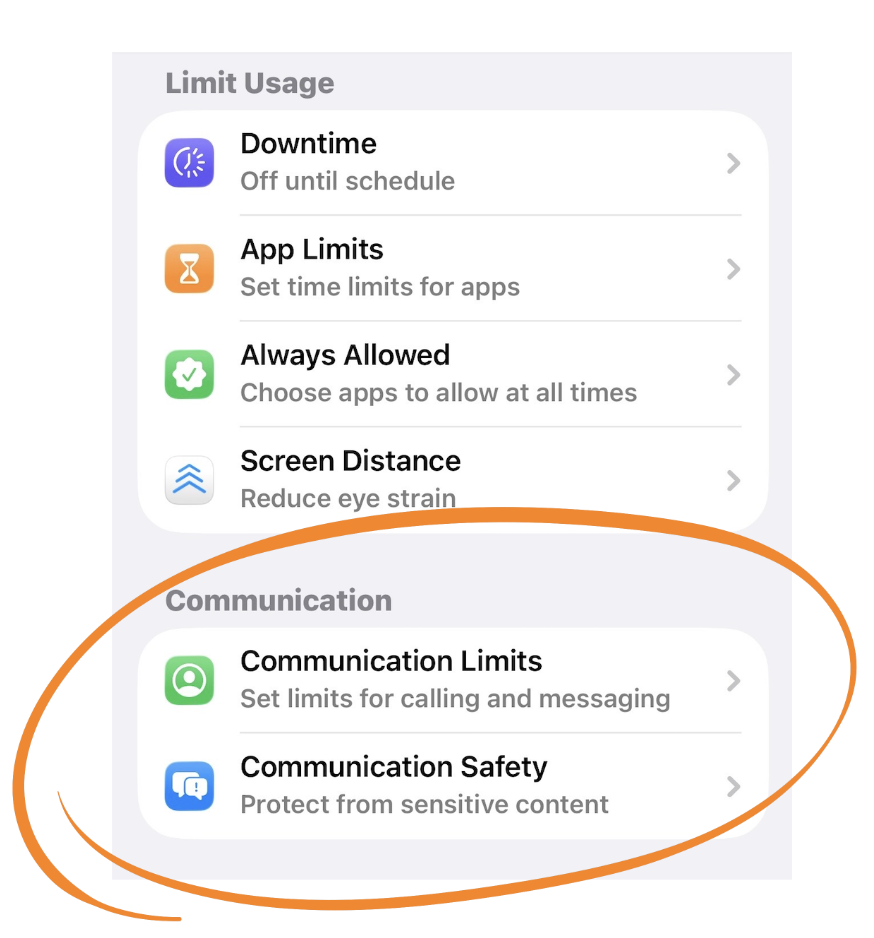
Within Apple Screen Time, you can set up “Communication Limits” and “Communication Safety” as additional guardrails when you first roll out texting. With “communication limits,” you can limit who your child can text with to only those listed in their contacts or to a short list of selected contacts only. It doesn’t prohibit group texting with those contacts, but it limits who they can group text with, so it’s a helpful tool for rolling out texting more slowly (or reeling it in if needed). And while you’re in there, “communication safety” is Apple’s built-in censoring of sensitive content like nudes.

Decide when and where texting is allowed.
Set a time limit: Because texting keeps grabbing attention. You can use screen time tools to set a time limit for messaging per day. Try 20 minutes per day for a new texter.
Set up Downtime: Downtime is a helpful Screen Time setting for parents. Learn more about using this tool on our Simplifying iPhones page.
Consider location boundaries: you can start by only allowing texting from a device that stays within a particular zone of your house (like on a device that stays on the kitchen counter). Or if you’re allowing wider access, make sure to keep it in check by preserving family meal times, car rides, and other times of value with family or friends. It helps to make any device-free zones clear for your family so devices (and texting) don’t chip away at precious opportunities for face-to-face connection. Print our signs or make your own!
Protect sleep! Set up a device charging location outside the bedroom. Stow any digital device one hour before bedtime. Kids often feel they need to stay up late texting to “be a good friend” so setting a tech bedtime (which includes texting) lets them blame us. Need tools to support this routine? See our favorite charging stations and alarm clocks!
Ready to teach texting? Let’s go!
Start with a proper orientation process. Download and print this texting guide: Let’s Talk about Texting from Wait Until 8th. Read through it with your child before allowing texting with friends. It outlines common obstacles and suggested ground rules - great for beginners! Think of this like “Driver’s Ed” for texting!
After reviewing the document together, help your child craft some initial messages and responses. Review messages together and discuss tone, wording, and what’s a good use of texting... maybe not being the one who constantly spams "hi hi hi hi hi hi hi hi" or 💩💩💩!
Set up a trial period. We always recommend starting any new tech privilege with a trial period "to see how it goes" so you can more easily change your mind if it is a flop. You can start with a week of texting to see how it goes. The end of that first week is a great chance to review texts, check in deeply about how it is going, and address any issues.
Set and enforce clear limits. Set clear expectations around when, where, and with whom texting is allowed. Scroll up to the section titled Ready to roll out texting? Get prepared first! to guide this step. Be explicit about what you believe is the right time and right place for texting (and what is not). Protect sleep by making sure all digital devices are off at least one hour before bedtime and charged overnight outside your child’s bedroom.
Spot check occasionally. Make it clear from the beginning that you will occasionally check your child’s texts, and remind them their friends’ parents are likely doing the same. Reviewing texts together typically works best and is a great way to keep kids on track for kind and respectful texting. The goal is not to sneak peeks, but to build mutual trust and open communication.
4 Steps to Reel in Texting
Group texting gone awry? It’s never too late to dial it back.
Go back to the basics. Download and print this Let’s Talk about Texting Guide from Wait Until 8th and talk through it with your child. It outlines common obstacles and suggested ground rules which can be a great "refresher" - even for more experienced texters.
Set or revisit limits around when, where, and with whom texting is allowed - scroll up to the section, Ready to roll out texting? Get prepared first!, for ideas. Rules and limits may need to be tightened. But make sure your child knows you’re on their team - trying to keep them safe and balanced since tech can be challenging to navigate and keep in check.
Check in with other parents. What are they observing? Do they want to get together to set some common ground rules and/or to reel things in together? For example, could everyone shut down texting at 9pm on school nights to take the pressure off? Or say no texting in the morning until after 8am? Co-creating limits makes it easier for everyone to enforce what are likely shared desires to keep texting in check!
Check in regularly & coach your child on tricky situations. Continue sharing teachable moments that arise during your own experiences as a texter. Scroll up a little and see Spot check occasionally for more tips. Above all, tell your child that you’re there for them to help them navigate the wild world of texting and all the complex situations that will certainly arise. If you’re seeing red flags, it may be worth taking a break from texting (if you can’t remove texting as a feature on your child’s device, you can set a 1-min time limit), getting help from a professional, and/or investing in a monitoring tool like Bark (which can be cumbersome to implement but may give you peace of mind).

COLLECTIVE ACTION: Get together with the parents of your child’s friends who are texting and suggest a “village mentality” where you all openly share observations, missteps, and other issues that come up so you can all benefit from teachable moments (without feeling judged!). It also helps to co-create ground rules and limits together to help everyone develop a healthy and balanced relationship with texting.
From a teen…
I am a sophomore in high school. I have been texting for a few years but I remember when I first started to text in 6th grade. It was really crazy. How I text with my friends now is SO different. Here’s a list of what I wish I knew when I first started texting.

You don’t have to reply right away (unless it’s your parent)!
You don’t have to be part of the conversation. It’s ok to just stay out of it.
You can leave a group chat if it doesn’t feel good. You can also mute it (hold on the thread and then click “hide alerts”)
Don’t be afraid to reply “Hey guys, chill” or “That’s not cool” to something you don’t like. Or leave a thumbs down!
If your parent wants to talk about texting with you - that’s good! It means they care and want you to be safe.
EVERY text you send is stored or saved somewhere or by someone. So don’t text anything you don’t want saved forever or that you wouldn’t share in person!
Get a grown-up’s help if something that is shared over text doesn’t feel right to you.