
Clinician Resources
ScreenSense provides health care professionals with resources and training to help families create a healthier relationship with technology
Tech overuse and misuse is negatively impacting the health and wellbeing of young people. Screen time too easily crowds out healthy activities like exercise, face-to-face socializing, and sleep. Families are struggling and need support. Pediatricians, therapists, school counselors, family consultants and other health care providers are trusted sources of guidance and are well-positioned to help caregivers navigate screen time decisions that affect health and wellbeing.
In collaboration with pediatric providers, ScreenSense created bilingual (English/Spanish) resources that guide families towards a balanced and healthy relationship with technology. These public health resources incorporate current American Academy of Pediatrics (AAP) recommendations alongside insights from leading researchers in the field. Grounded in both clinical guidance and real-world practice, our guidelines give providers evidence-based resources that address one of the most pressing health topics facing kids and families today.
ScreenSense provides a 60-minute training program that equips health care professionals with the resources and talking points to confidently guide youth and families toward healthier tech habits.
Healthy Tech Use Guidelines
These concise, informative, and actionable resources are designed to support healthy tech use across different stages of childhood and provide clinicians a way to talk about tech with parents and caregivers. Handouts cover practical strategies such as setting boundaries, protecting sleep, modeling healthy tech use, and introducing technology gradually. All materials are available in English and Spanish and include QR codes linking to additional resources on the ScreenSense website.
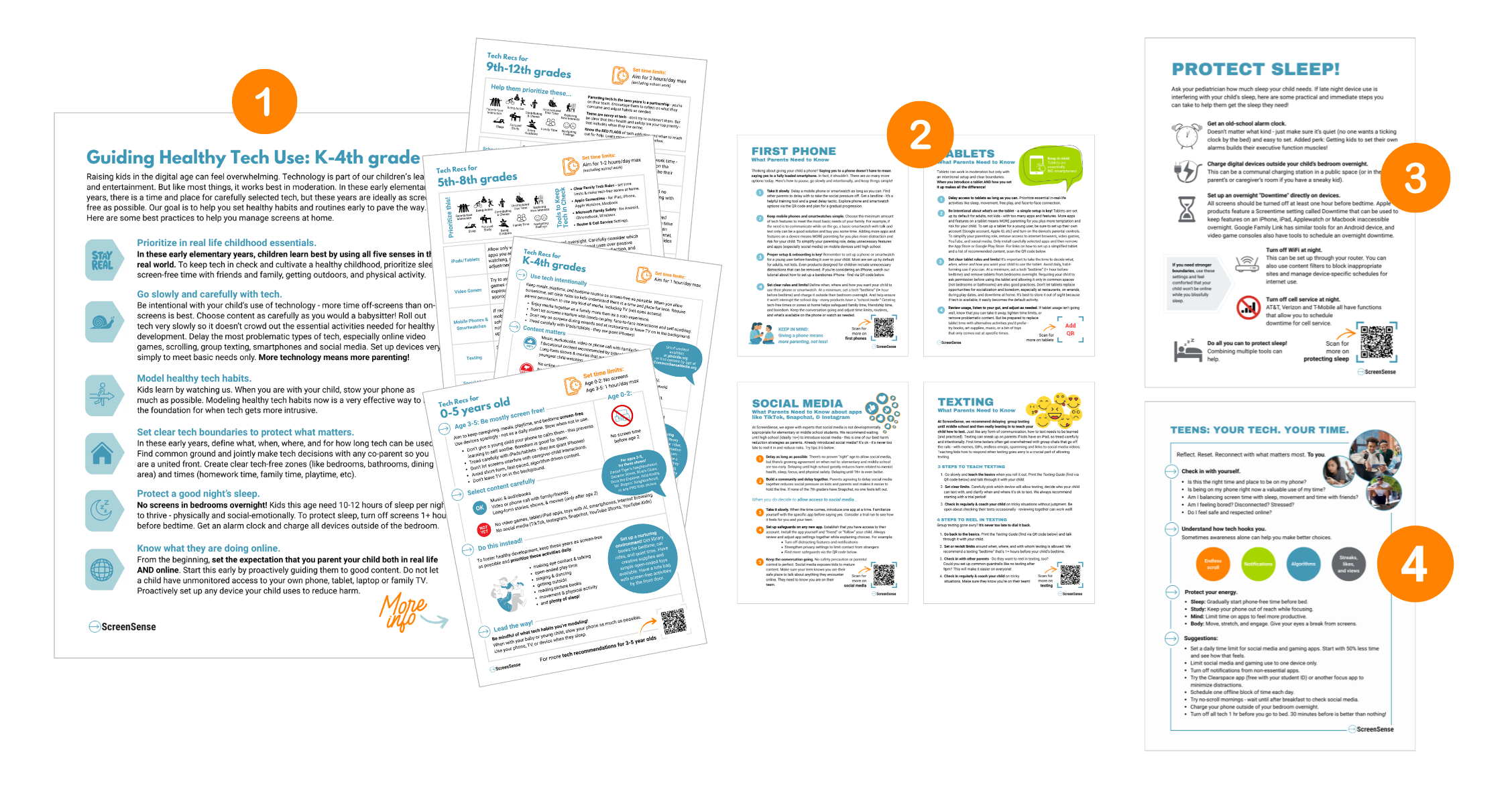
There are four types of ready-to-share handouts that clinicians can distribute:
Anticipatory guidance by age group (ages 0-5, grades K-4th, grades 5-8th, grades 9-12th) to easily share during clinic visits
Topic-specific handouts to share as needed when parents are at critical junctures like managing a tablet, introducing a cell phone, or navigating social media use
A handout on the importance of protecting sleep from the influx of tech, including practical ways to get mobile devices out of bedrooms at night
A handout for teens - encouraging self reflection and creating open dialogue around tech. Teens often tune out their parents on topics like screen time and social media but just one or two questions asked by their pediatrician or other medical professional can help them course-correct.
The handouts pair with our online guidelines by age and grade. Together, these resources help parents roll out tech slowly and intentionally with clear boundaries so screen time does not displace childhood essentials.
Rolling out our Healthy Tech Use Guidelines
To equip clinicians to use the above resources, we offer a 60-minute training program. By the end of this session, clinicians leave with a clearer understanding of the research, concrete talking points for patient and family conversations, and a roadmap for incorporating these Healthy Tech Use Guidelines into their clinic flow.
The training includes an overview of:
The Research. We review how technology use and misuse is affecting child and adolescent development, mental health, and well-being.
The Clinician's Role. We take a closer look at why clinicians are uniquely positioned to influence healthy tech habits, and how they can leverage their trusted relationships with youth and families to drive meaningful change.
Age-Specific Guidance around Tech Use. Our practical and developmentally appropriate tech recommendations make it easier to help families navigate tech decisions at home.
Warning Signs and Red Flags. We help clinicians know when to provide guidance and when a referral may be needed.
Implementation Pathways. We discuss ways to integrate our Healthy Tech Use Guidelines into your everyday practice, with flexible options to meet the needs of different clinical settings.
To learn more about this training, including cost and availability, email us at info@screensense.org.
Need an overview of our resources for clinicians to share with colleagues or introduce at a team meeting? Download this one-page PDF.
References
Our recommendations reflect the latest research and guidelines from clinicians, child and adolescent development experts, and key organizations. Resources are listed below.
American Academy of Pediatrics: Digital Ecosystems, Children, and Adolescents (2026); AAP Media and Young Minds (2016; 2022); AAP’s Center of Excellence on Social Media and Youth Mental Health.
U.S. Surgeon General’s Warning on the Harms of Screen Use: An Advisory Toolkit on How to Protect Children and Adolescents (2026)
U.S. Surgeon General’s advisory on social media and youth mental health (2023).
American Academy of Child and Adolescent Psychiatry (AACAP): Screen Time and Children (2025).
American Psychological Association: Health Advisory on Social Media use in adolescence (2023).
WHO’s Guidelines on physical activity, sedentary behaviour and sleep for children under 5 years of age (April 2019).
The Anxious Generation (Jonathan Haidt, 2024).
10 Rules for Raising Kids in a High Tech World (Jean Twenge, 2025)
Research and resources developed by Children and Screens.
Resources by Screen Time Action Network at Fairplay; for example, Be Tech Wise with Baby.
A parent’s guide to young children in the digital age, created by Nancy Carlsson-Paige, Ed.D.
Digital Media and Video Game Use Recommendations by Age, created by the Digital Media Treatment and Education Center.
ScreenSense Healthy Tech Use Guidelines were made possible by generous support from Harbor Point Charitable Foundation and Marin County Community Grants & Investment Program (CGIP).